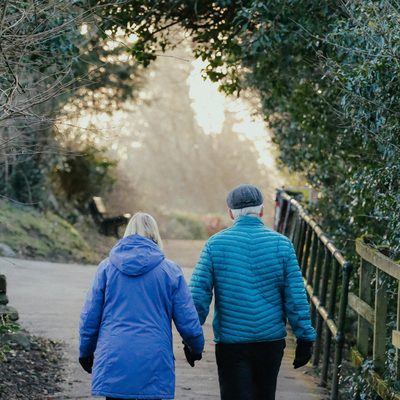
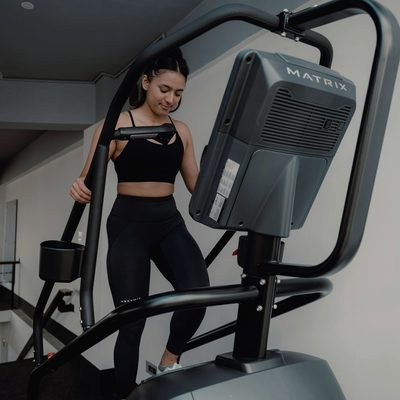
That isn't a willpower problem. It's a protocol problem. The Japanese Walking Method turns the same thirty minutes into measurable fat loss, lower blood pressure, stronger legs, and a higher VO₂ max. The last is the body's clearest longevity signal. Five products, one shelf, all built on the same published trial.

The LibraryContents
Five products, all built on the same clinical-walking protocol. Start with the book, deepen with the workbook, walk with the audio. Or pick the one that fits you — over-sixty, or indoor on a treadmill. One method, five ways to walk it.
The Japanese Walking Method
The method is simple, which is why it works. Inside one thirty-minute walk you alternate between a pace you can talk-but-not-sing at, and a pace that feels easy. Five rounds. Four sessions a week. Four weeks.
The pace where you can speak in short sentences, but not sing. Heart rate climbs. Your body is asked to adapt, not endure.
A pace that feels comfortable. Lungs catch up. Heart rate falls. The recovery is where the adaptation happens.
Thirty minutes total. Four sessions a week. Four weeks until the fat starts shifting, the cuff number falls, and the legs strengthen. No track. No gym. No app required.
The protocol is sometimes called Interval Walking Training, or IWT. The Japanese Walking Method is the popular name for the version developed at Shinshu University and published in Mayo Clinic Proceedings. The trial reported a seventeen per cent rise in VO₂ max in the interval group — the body's peak oxygen uptake. A JAMA meta-analysis of more than a hundred thousand adults found every one-MET gain in cardiorespiratory fitness lowers all-cause mortality by thirteen per cent. It is the strongest single longevity signal a person can measurably move.
The Proof
Two hundred and forty-six adults. Five months. Interval walking against steady-pace walking, head-to-head. Published in Mayo Clinic Proceedings, the medical journal of the Mayo Clinic.
Resting systolic, after five months of interval walking. A clinically meaningful change at any age, larger for older adults.
Interval walking outpaces steady-pace walking on weight lost when total training time is equal — a British Journal of Sports Medicine meta-analysis put the gap at roughly forty per cent across comparable studies.
A seventeen per cent rise in VO₂ max in the interval-walking group — the body's peak oxygen uptake, and the single strongest predictor of all-cause longevity in mainstream cardiology. A JAMA meta-analysis of over 100,000 adults found every one-MET gain in aerobic fitness — roughly the gap between a sedentary adult and a brisk walker — lowers all-cause mortality by thirteen per cent.
Quadriceps strength — measured with isokinetic dynamometry — climbed 13% in the interval-walking group versus the steady-walking control.
Hamstring strength — knee flexion, measured with isokinetic dynamometry — rose seventeen per cent in the interval-walking group. The largest single strength gain the trial reported.
Peak aerobic capacity for walking — the trial's own walking-specific measure — rose nine per cent in the interval group. The number that translates most directly into feeling less out of breath on the daily walk.
Available NowThe Shelf
Browse by edition. Each tile opens its own page — the long-read of the protocol, the proof, what's inside, and how to buy. Every product is delivered as a downloadable file the same day.
Field Guide Free
Eight pages. The protocol on one page, the talk test, day one start-line, and a six-walk Week-One schedule. The free PDF that gets you walking the Japanese Walking Method by tomorrow morning.
Enter your email. The PDF arrives in the welcome message, immediately. One short letter a week after that, when there’s something to say. Unsubscribe whenever.